
You already put real effort into your garden beds. The perennials you planted last fall. The raised vegetable beds you’ve been nursing since May. The shade garden under the maple that took three seasons to get right.
So it’s a fair question: should you be watering them better?
Drip irrigation comes up a lot when Ontario homeowners start thinking seriously about their gardens — but there’s a lot of noise around it. Some people swear by it. Others assume it’s complicated, expensive, or only relevant for farmers. The truth is somewhere more practical, and this guide will walk you through it honestly.
The Short Answer
Is drip irrigation worth it for Ontario garden beds? For most homeowners — yes.
Drip irrigation delivers water directly to plant roots, bypassing evaporation and runoff. It uses up to 50% less water than overhead watering, produces healthier plants, reduces disease pressure, and works especially well for vegetable beds, flower borders, shrub beds, and raised planters. When integrated with your existing irrigation system it is easy to manage and virtually invisible in the garden.
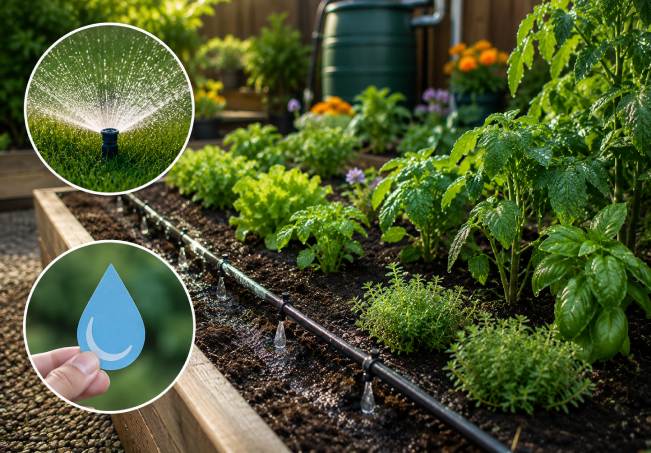
Drip irrigation — sometimes called trickle irrigation or micro-irrigation — delivers a slow, steady supply of water directly to the root zone of each plant through a network of tubing and small emitters. Rather than spraying water through the air and onto foliage, it releases water right at soil level, exactly where it does the most good.
Emitters typically deliver water at a rate of 0.5 to 4 litres per hour. That sounds slow — and it is, deliberately. The goal is gentle, deep penetration into the soil that mimics a slow soaking rain, not a brief downpour that runs off before it can absorb.
The system is made up of a few simple components: a main supply line, lateral distribution tubing, individual emitters positioned at each plant, a filter to keep sediment out, and a pressure regulator to ensure consistent flow. In a residential garden setting it is typically low-profile, sits just at or below the soil surface, and can be largely hidden by mulch.
If you already have an in-ground irrigation system on your property, you might be wondering whether drip is even necessary — your lawn zones reach the garden beds anyway, right?
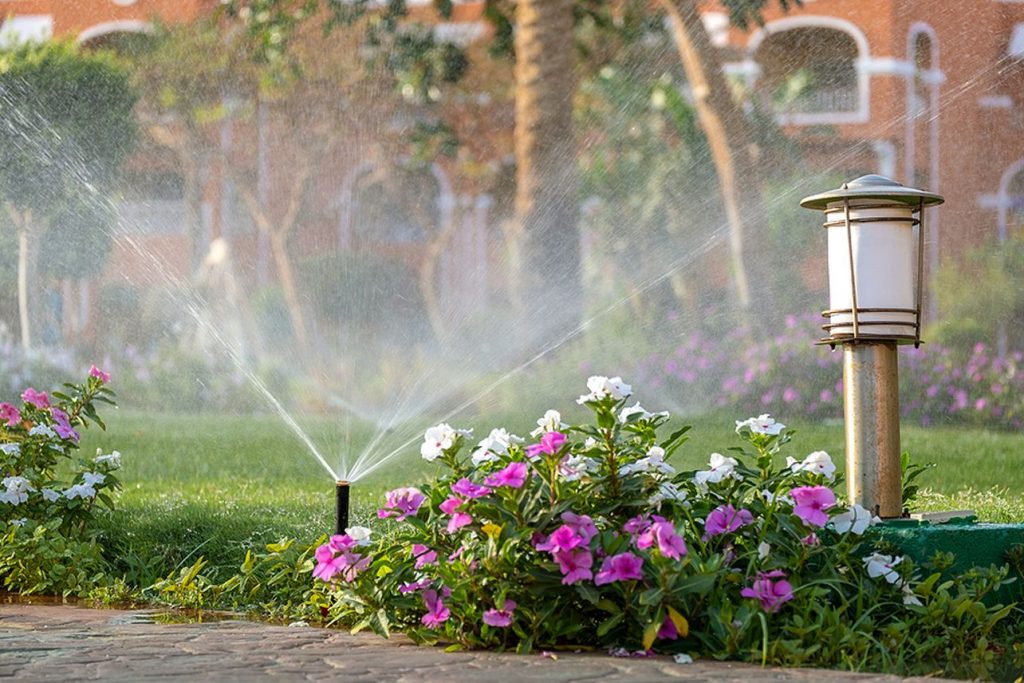
Here is the problem with that. Spray and rotor heads are designed for turf. They deliver water at a rate and coverage pattern that works well across open grass, but when that same water hits a garden bed it causes a few issues:
Drip solves all of these at once. Each emitter is sized and placed specifically for the plant it serves, water goes underground rather than through the air, and foliage stays dry.
Tip: If Your Garden Beds Are on a Lawn Zone
This is one of the most common inefficiencies we see in Burlington properties. Mixing garden beds into a lawn irrigation zone typically means either the lawn is underwatered or the beds are overwatered — rarely both are right at the same time. A dedicated drip zone solves this and usually pays for itself in reduced water use within a season or two.
This is where drip irrigation makes a compelling case for itself, particularly for Ontario homeowners who are conscious of their water use and utility bills.
Compared to conventional overhead watering methods, drip irrigation can reduce water use in garden beds by 30 to 50 percent, according to research across residential applications. Some estimates put savings even higher in hot, dry conditions where evaporation from spray heads is at its worst.
The U.S. EPA’s WaterSense programme — widely referenced by Canadian irrigation professionals — notes that as much as 50 percent of water used in landscape irrigation is wasted through evaporation, runoff, and poor system design. Drip irrigation, by its nature, eliminates most of those loss points.
For Burlington and Halton homeowners, this matters in two ways. First, it directly lowers your water bill during the growing season. Second, it reduces the load on your outdoor water use during periods when Halton Region’s multi-stage water restriction framework could be activated — protecting your garden even when watering hours are limited.
If you are already thinking about water efficiency across your property, our article on how much water a SMART irrigation controller can save is worth reading alongside this one — the two approaches work particularly well together.
Water savings are the most measurable benefit, but many gardeners say the improvement in plant health is what surprises them most after switching to drip.
Here is why: plants are happiest when their root zone stays consistently moist — not waterlogged, not drought-stressed, but steadily hydrated. That is exactly what a well-designed drip system delivers. The slow, regular supply of water encourages deep root development, which makes plants more resilient to summer heat and less likely to struggle during dry spells.
For vegetable beds, drip irrigation is especially effective. Tomatoes, peppers, cucumbers, and squash are all sensitive to inconsistent watering — fluctuating moisture levels are one of the primary causes of blossom-end rot in tomatoes and splitting in tomatoes and peppers. Keeping the root zone evenly moist through drip essentially eliminates this problem.
Leafy greens — lettuce, spinach, kale — stay cleaner and last longer when water is not splashing soil onto leaves. Herbs like basil, parsley, and cilantro, which can be prone to root rot from overwatering, do much better when moisture is delivered precisely and consistently.
Established perennial and shrub beds benefit from drip in a different way. Once plants are rooted in, they do not need daily watering — but they do need deep, infrequent watering that pushes moisture down to where the root system actually lives. Drip handles this naturally, and because foliage stays dry, the fungal disease pressure that plagues many Ontario gardens in humid July and August is significantly reduced.
Raised beds dry out faster than in-ground planting because they have more surface area exposed to air and sun. Drip irrigation is probably the single best upgrade you can make for a raised bed garden — it keeps moisture consistent without the daily hand-watering that raised beds often demand during an Ontario summer.

If you already have a professionally installed sprinkler system on your Burlington property, adding drip to your garden beds is typically straightforward. It is added as a dedicated zone — separate from your lawn zones — fed from the same controller and water supply.
This matters because it means your drip zone can be programmed on a completely different schedule from your lawn. Garden beds generally water better at dawn with longer, less frequent cycles. Your lawn might run on a different cadence entirely. With separate zones, each area gets exactly what it needs without compromise.
The integration also means your drip zone can benefit from SMART controller technology — weather-linked scheduling that automatically skips a watering cycle when rain is in the forecast or when soil moisture sensors indicate the ground is already adequately hydrated. For vegetable beds especially, that kind of precision matters.
Related Reading
How Much Water Can a SMART Irrigation Controller Save?
How to Ensure Your Inground Irrigation System Is Not Wasting Water
Not every situation calls for drip — but here is where it consistently outperforms other approaches:
It is worth noting that drip is generally less suited to large open lawn areas, which is why a combined approach — traditional rotor or spray zones for the lawn, drip zones for the beds — is the most common configuration we design for Burlington properties.
This is a very common situation. Many Burlington and Oakville homeowners have had irrigation systems for years that cover the lawn well but leave garden beds either unwatered or lumped into a spray zone that is not doing them any favours.
Adding a drip zone to an existing system falls under what we call a system retrofit. It typically involves adding a new zone valve, running a supply line to the bed area, and installing the drip tubing and emitters. The existing controller simply gets a new zone programmed in.
The cost is generally modest relative to a full system installation, and the payback in water savings and plant health is usually noticeable within the first growing season. If your system is older and you are considering broader improvements, a retrofit evaluation is a good opportunity to look at the whole picture — controller upgrades, head adjustments, and drip additions can all be handled at once.
One concern homeowners sometimes raise is maintenance — drip tubing sounds delicate, and emitters sound like they would clog constantly. In practice, a well-installed residential drip system with a proper filter is quite low-maintenance.
Here is what ongoing care actually looks like:
The main thing to avoid is treating drip lines like in-ground sprinkler pipe — they sit at or just below the surface and can be damaged by aggressive digging or aggressive weeding. Once you know where the lines run, it becomes habit to work around them.
Let us be straightforward about this. A professionally designed and installed drip zone is not free — but it is also not expensive relative to the value it delivers, especially when added alongside an existing irrigation installation or system retrofit.
What you are paying for is:
The DIY drip kits available at hardware stores can work — but they are typically designed around generic bed layouts and rarely account for the variations in water pressure, plant spacing, and zone scheduling that a custom installation handles properly. Many of the repair calls we get involve DIY drip setups that have developed leaks, inconsistent flow, or emitter failures within a season or two.
If you are serious about your garden and want a system that genuinely performs, professional installation is worth the difference. To get a clear sense of what it would involve for your property, the best starting point is a free quote from our team.
If there is one upgrade combination that makes an outsized difference for Burlington homeowners, it is drip irrigation zones paired with a SMART irrigation controller.
Here is why they work so well together: a smart controller uses real-time weather data, local evapotranspiration rates, and soil moisture information to determine when watering is actually needed. For a vegetable garden or perennial bed, that precision is especially valuable — you are not just saving water in the abstract, you are applying exactly the right amount at exactly the right time for your specific plants.
The combination also means your drip zone adjusts automatically when rain arrives, when temperatures drop, or when the soil is already adequately moist. For a vegetable garden trying to hit the narrow window of consistent moisture without waterlogging, that is a real practical advantage — not just a technology talking point.
For more on what smart controllers can do, see our guide on SMART irrigation and water conservation.
Whether you are starting from scratch or looking to improve an existing system, adding drip irrigation to your garden beds is one of the most impactful upgrades you can make this growing season.
Our team at Nutri-Lawn Burlington has been designing and installing irrigation systems across Burlington, Oakville, Mississauga, and Hamilton for over 30 years. We know the local soil conditions, the climate quirks of Southern Ontario summers, and how to design a system that performs reliably year after year.
Request a free quote and we will assess your property, your existing system if you have one, and put together an honest recommendation for your specific beds and garden layout. No pressure — just a clear picture of what would work and what it would cost.
You can also browse our frequently asked questions or explore more irrigation guides on our articles and guides page.
